Setup: one alignment per face
Place the prism on an adjustable table, read a on face A, rotate the table and read b on face B. The rotation axis should pass through the prism edge to avoid lever error between table rotation and prism angle.
A common student mistake is moving the instrument to the second face. The instrument must stay fixed and only the prism table moves — otherwise the two readings are not on the same datum.
Readings and statistics
Take 6 readings per face and average; compute the experimental standard deviation. Teaching example: face A mean 12′34.20″, s = 0.15″; face B mean 12′31.60″, s = 0.18″; dihedral difference 2.60″.
Compare the difference against nominal 90° to judge the prism angle error, and watch how ambient temperature drift affects repeatability.
Uncertainty budget
Components: instrument indication error (certificate), repeatability (experimental standard deviation), alignment error (estimated), temperature effect (estimated). Combine into u_c and state the expanded uncertainty U with k=2.
Teaching budget: u_c ≈ 0.35″, U ≈ 0.7″ (k=2); conclusion phrasing: "dihedral angle 90°00′02.6″ ± 0.7″ (k=2)".
Case workflow, animated
- Confirm the task and datum
- Lay out stations by span
- Acquire readings and convert
- Evaluate and verify
The animation follows the station layout and calculation order of this case. Values are teaching data.
Case data are teaching assumptions. The lab trains procedure and statistics and is not a calibration verdict for the physical prism; formal calibration follows the applicable national metrology specification.
Recommended instruments
Dual-axis autocollimator, accuracy 0.1″
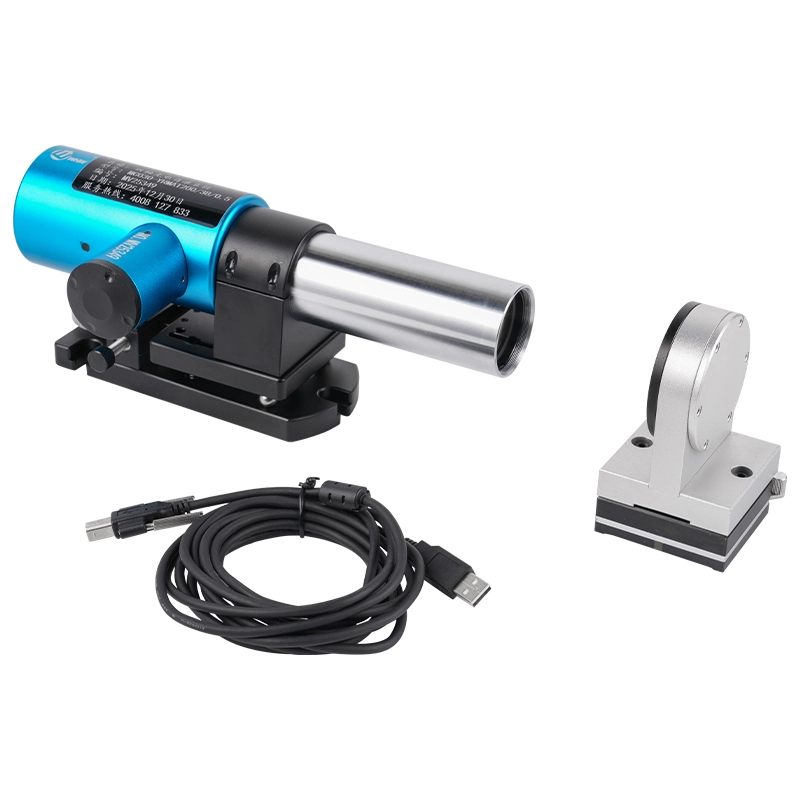
Dual-axis electronic autocollimator accuracy 1″ maximum measuring distance 10m