Why closure matters
A full revolution should return to the starting position. The return-to-zero difference reflects drift, a loose setup or a recording error, and it is the first check on whether the data set is usable.
Closure error is not indexing error. It cannot be used to correct individual positions; it only signals whether a repeat is needed.
Acquisition
The polygon is mounted at the table centre and the autocollimator stays fixed. Read once every 30° for 12 positions, then return to 0° and read again.
Before reading, confirm the polygon face is clean and the table is clamped, and allow enough settling time at each position.
Readings and deviations
Subtracting nominal angles, the deviation sequence in arcseconds is −0.3, 0.2, 0.6, 1.0, 1.2, 0.9, 0.5, 0.1, −0.4, −0.8, −1.1, −0.6.
Maximum deviation +1.2″, minimum −1.1″, peak-to-valley 2.3″. The 0.2″ return-to-zero difference indicates stable data, so no repeat is needed.
Conclusion
The 2.3″ peak-to-valley exceeds 2″, and +1.2″ at position 5 exceeds ±1″, so the table fails. The smooth distribution suggests a systematic drive or graduation error rather than local damage.
Build a compensation table or service the indexing mechanism and repeat. A compensation table applies only to that table and that position sequence.
Case workflow, animated
- Confirm the task and datum
- Lay out stations by span
- Acquire readings and convert
- Evaluate and verify
The animation follows the station layout and calculation order of this case. Values are teaching data.
Teaching data. The reference artefact's own error is not separated; a real report corrects for its grade and states uncertainty.
Recommended instruments
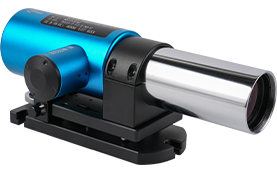
Dual-axis autocollimator, accuracy 0.1″
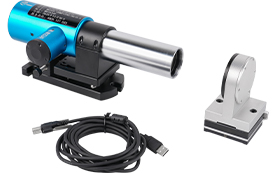
Dual-axis electronic autocollimator accuracy 0.3″ maximum measuring distance 10m