Why the polygon must be calibrated
The polygon has its own error. Treating it as absolute gives table error plus polygon error, inseparable. A calibrated polygon lets you subtract the known part.
Without a certificate, reverse the polygon 180° and average the two runs to cancel its first harmonic. That handles part of the error only, not a substitute for calibration.
What was measured
The twelve deviations are −1.2, +0.6, +1.8, +0.4, −0.9, −1.5, −0.3, +1.1, +2.0, +0.5, −1.0, −1.5 arcseconds: 3.5″ peak-to-valley, near-zero mean.
The curve undulates slowly without alternating jumps, so the worm mesh is continuous and the error is accumulated helix error rather than one bad tooth.
Compensation and verification
Negating the deviations into the control brings residuals under 1.8″. The table only holds at measured positions; intermediate points are interpolated and not necessarily linear.
After compensation, compare directions again: if the reversal difference grows from 0.4″ to 0.9″, the table has absorbed backlash and the reverse segment needs re-identification.
Case workflow, animated
- Confirm the task and datum
- Lay out stations by span
- Acquire readings and convert
- Evaluate and verify
The animation follows the station layout and calculation order of this case. Values are teaching data.
Teaching data. Real verification follows JJF or ISO 230-1 with multiple points, directions and repeats; a single 12-position polygon run cannot conclude a full circle.
Recommended instruments
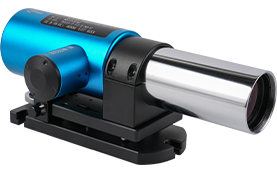
Dual-axis autocollimator, accuracy 0.1″
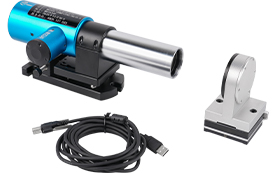
Dual-axis electronic autocollimator accuracy 0.3″ maximum measuring distance 10m