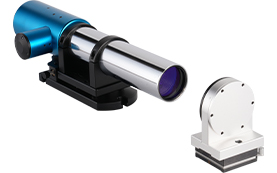
Setup: coaxiality first
Mount the polygon on the encoder shaft via an arbor and centre eccentricity within 5 μm; the autocollimator stands on an independent support and does not rotate. Eccentricity adds a second harmonic to the result and must be removed first.
Aim the optical axis at face-centre height and warm up the instrument for at least 30 minutes before sampling.
Readings: face-by-face comparison
Stop at each face, record the encoder output and the autocollimator reading; after 23 points repeat in reverse. The forward/reverse difference shows backlash and friction; the average feeds the positioning error evaluation.
Teaching example: at face 7 the encoder reads 109°33′54.8″ and the autocollimator converts to 109°33′53.1″, a deviation of +1.7″ at that point.
Calculation: closure and the error curve
Polygon face angles have calibration certificate values; correct the autocollimator readings with them and take point-wise differences to obtain the encoder error curve. The closure error of a full revolution should stay below twice the measurement repeatability, otherwise recheck clamping and temperature.
Fourier decomposition of the curve: the first harmonic usually comes from residual eccentricity, higher orders reflect the encoder grating error itself.
Limits of the conclusion
The method evaluates the positioning error of the shaft-plus-encoder assembly; isolating the encoder alone needs a higher-grade spindle or a multi-head separation method.
Example readings and curves are teaching assumptions that illustrate the calculation and are not measured results for any specific encoder product.
Case workflow, animated
- Confirm the task and datum
- Lay out stations by span
- Acquire readings and convert
- Evaluate and verify
The animation follows the station layout and calculation order of this case. Values are teaching data.
Case data are teaching assumptions. Encoder acceptance follows the manufacturer specification and the test conditions agreed by both parties; polygon grade, autocollimator accuracy and environment together set the achievable uncertainty.
Recommended instruments
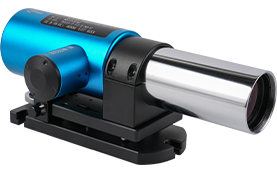
Dual-axis autocollimator, accuracy 0.1″
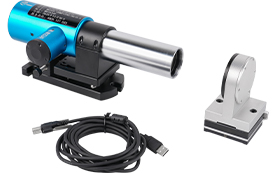
Dual-axis electronic autocollimator accuracy 0.3″ maximum measuring distance 10m