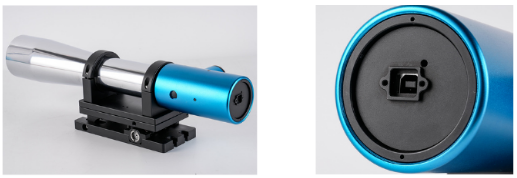
Animated explanation
- Establish the geometry
- See how one reading forms
- Change a condition and observe
- Return to the formula and its limits
The animation explains relationships and directions. Read numbers from the formula, the standard and your records.
Optical path: from reticle to detector
A light source illuminates a reticle placed near the focal plane of the objective. The crosshair or mark becomes a parallel beam after the objective.
The beam returns from the plane mirror along the same path, passes the objective again and forms an autocollimated image of the reticle near the focal plane. A beamsplitter directs the return beam to a photoelectric detector, and software computes the image centroid.
Why the reading is twice the mirror angle
The law of reflection gives a simple result: with a fixed incoming direction, rotating the mirror by θ rotates the reflected beam by 2θ. This is the optical lever.
The image shift on the focal plane is x = f·tan(2θ) ≈ 2f·θ, hence θ = x/(2f). A longer focal length f produces a larger shift for the same angle, so angular sensitivity rises with focal length.
From image position to an angle reading
The detector measures the image shift in two directions and software converts it into arcseconds using calibration factors. A dual-axis instrument reports azimuth and elevation at the same time.
Resolution describes the smallest displayed step, for example 0.1″ or 0.01″. It is not accuracy. To judge a reading, check the indication error within the stated range and the repeatability.
What it measures and what it does not
An autocollimator measures the change of the mirror normal direction. It does not measure length, displacement or surface roughness directly.
Height differences, straightness and flatness are derived from angles together with the base span, the measurement layout and the evaluation algorithm. A report therefore has to state span, station positions and evaluation method.
Related methods and industries
Recommended instruments
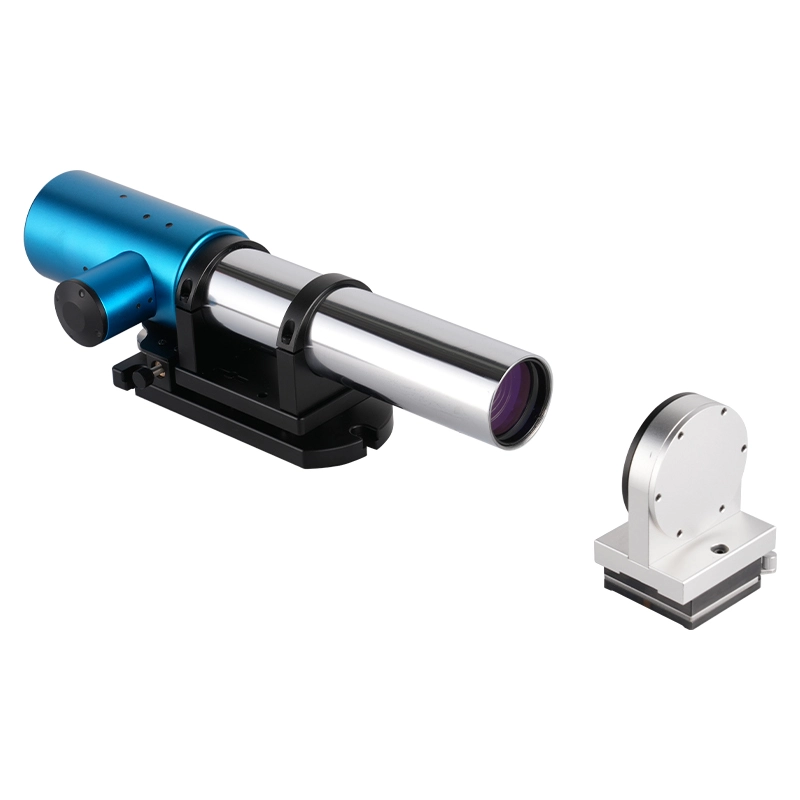
Dual-axis autocollimator, accuracy 0.1″, range 30 m
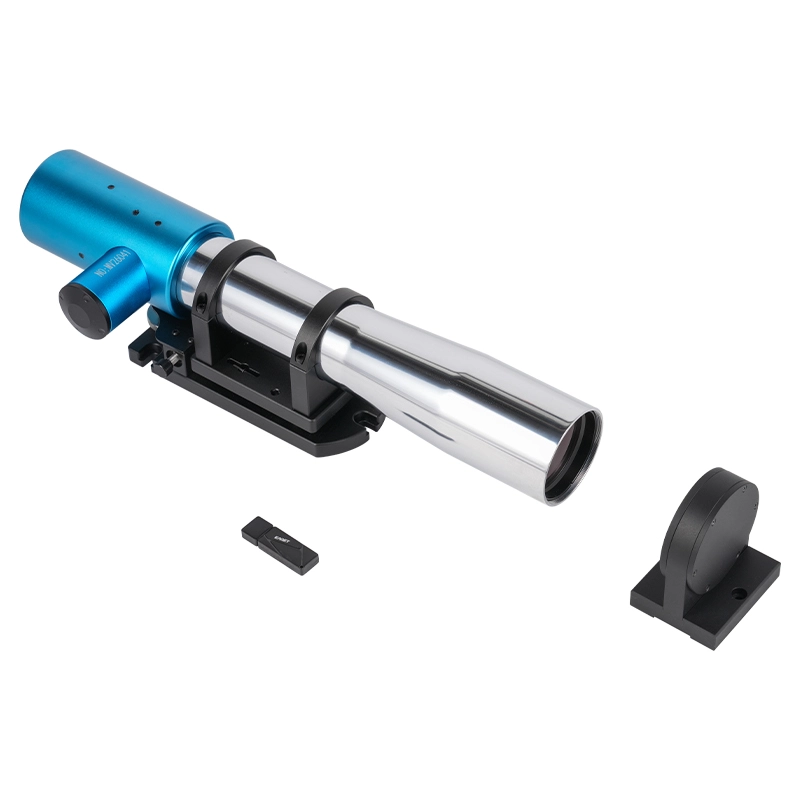
Dual-axis autocollimator, accuracy 1″, range 40 m